How it works in short
The app puts an Amazon Pay button in your cart, and if you want, on product pages too. A shopper clicks it and signs in with Amazon. Back in your store, the checkout is filled in from their Amazon account: the email, the shipping address, and at the payment step Amazon Pay with the card they chose at Amazon. They place the order as usual.
- Shoppers can switch to another address or payment method from their Amazon account with the Change address and Change links.
- Amazon Pay shows at the payment step only for shoppers who started with the Amazon Pay button.
- It doesn't work for stores shown inside a Wix site (the store is in an iframe there).
You need five things from Amazon Pay: your Merchant ID, a Store ID, a Public Key ID, the private key file (.pem) and your region. Here is where to get them.
1. Create your Amazon Pay account
If you are new to Amazon Pay, first register your business account. Then add the Amazon Pay app to your store and open it. The Get Amazon Pay live steps at the top tick themselves off as you go: connect your Amazon Pay account, turn Amazon Pay on at checkout, switch to live payments.
2. Get your keys in Integration Central
- Open Amazon Pay Integration Central for your region: US, EU and UK, JP.
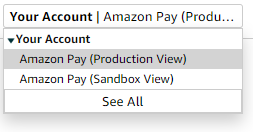
- In the marketplace switcher at the top, choose Amazon Pay (Production View) for live
keys. For test keys, choose Amazon Pay (Sandbox View) instead.
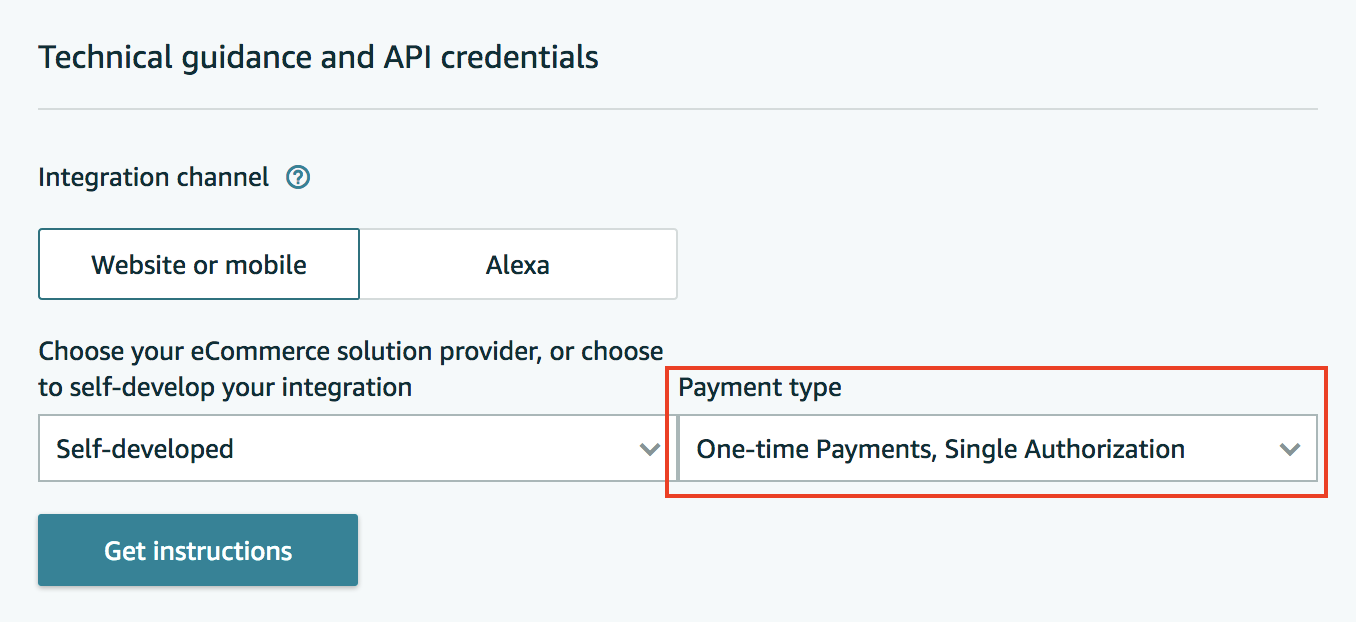
- Under Technical guidance and API credentials, choose Self-developed, keep the payment type One-time Payments, Single Authorization, and click Get instructions.
- Create a Store ID (if you don't have one for your store yet):
- Go to Manage client ID/store ID(s) and click Create new client ID/store ID.
- Enter an Application or store name, for example "My Store".
- Under JavaScript origins, add your store's address, for example
https://www.example.com/. Amazon can take up to 48 hours to verify a new origin, so add it early. - The Store ID usually starts with
amzn1.application.
- Create the API keys:
- Go to the API keys section and click Create keys.
- Keep Generate API credentials, give the keys a name you will recognize, and click Create keys.
- Your browser downloads the private key, a .pem file. Keep it safe: this is the only time you can download it. If you lose it, create a new key pair.
- Copy the Public Key ID. It starts with
LIVE-orSANDBOX-, and you can come back to it later.
- Copy your Merchant ID, also shown in Integration Central.
Already have a Store ID, but without your store's address? Open Manage client ID/store ID configurations, choose it, click Edit, add your store's address under JavaScript origins and save. Amazon Pay also has an official video of these steps.
3. Paste the keys into the app
In the app, fill in:
- Merchant ID, Store ID and Public Key ID.
- Private key (the .pem file): open the .pem file in a text editor and paste all of it,
from
-----BEGIN PRIVATE KEY-----to-----END PRIVATE KEY-----. Not the Public Key ID: that has its own field. - Region: US, EU, UK or JP, the region of your Amazon Pay account.
- Cart page link: open your store's cart page and copy the whole address from your
browser, for example
https://my-domain.com/cart. Shoppers come back to this page after signing in with Amazon. - Sandbox Mode: on while you test.
Click Save. The app checks your keys with Amazon Pay right away and shows the result under the form. "Saved. Amazon Pay accepted your keys." means you are connected. If you saved sandbox keys, the message reminds you that payments are test payments. If Amazon Pay refuses the keys, the message says what to change: often the region, or sandbox and live mixed up. Keys made since 2021 carry their mode in the Public Key ID (SANDBOX- or LIVE-), and Amazon goes by that.
4. Choose how the button looks
- Amazon Pay Checkout button color: Gold, LightGray or DarkGray.
- Inform your customers that your shop is accepting Amazon Pay: shows the Amazon Pay button on product pages, under the add to bag button. A click adds the product to the cart and opens the cart.
- Payment method name at checkout: the name at the payment step (Amazon Pay by default).
- "Change payment" label and "Change address" label: the link texts shoppers use to pick another payment method or address from their Amazon account. Translate them if your store isn't in English.
- Custom CSS: your own styles for the product page button.
In the cart, the button sits under the checkout button:

5. Turn on Amazon Pay at checkout
In your store admin, open the Payment settings and switch Amazon Pay on. The app's Open payment settings button takes you there. Shoppers who came through the Amazon Pay button then see it at the payment step with their Amazon payment method:

6. Make a sandbox order, then go live
With sandbox keys and Sandbox Mode on, add a product to the cart, click the Amazon Pay button and sign in with an Amazon Pay sandbox test account. Check that you come back to the cart, that the checkout is filled in, and that the order is placed. Then create live keys in the Production View, paste them, switch Sandbox Mode off and save.
Common setups
A store in Germany or France
Use Integration Central EU, choose EU as the region, and translate the "Change payment" and "Change address" labels into your store's language.
A store in the UK
Use Integration Central EU for the keys and choose UK as the region.
Amazon Pay on product pages
Switch on Inform your customers that your shop is accepting Amazon Pay. Shoppers see the button before they open the cart.
A button that fits a dark or minimal store
Set Amazon Pay Checkout button color to DarkGray or LightGray.
Questions
What do I paste in the private key field?
The whole content of the .pem file your browser downloaded when you created the API keys. Not the Public Key ID.
Why don't shoppers see Amazon Pay at the payment step?
Amazon Pay shows there only for shoppers who started with the Amazon Pay button in the cart or on the product page. Also check that the app has all keys and the cart page link saved.
My store is on Wix. Can I use Amazon Pay?
Unfortunately not: on Wix the store is shown inside an iframe, and Amazon Pay can't work there.
What are the Amazon Pay fees?
Amazon Pay charges per transaction. See Amazon Pay's fees page.